

April, 2026
Plagiocephaly Measurements Made Easy with Skully Care
Brachycephaly is a form of flat head syndrome characterised by a flattening of the back of the skull, resulting in a head that appears wider and shorter than average. Unlike plagiocephaly, which causes asymmetrical flattening on one side, brachycephaly affects the back of the head more symmetrically. It is one of the most common positional skull deformities seen in infants, affecting a significant proportion of babies in the first months of life. Early identification through accurate brachycephaly measurement is essential, as it determines whether a conservative repositioning approach is sufficient or whether further intervention is needed.
Brachycephaly vs plagiocephaly: understanding the difference
While brachycephaly and plagiocephaly are both positional skull deformities, they differ in shape and in how they are measured. Brachycephaly is defined primarily by the Cephalic Index (CI), which measures the ratio of head width to head length. A CI above 90 is considered indicative of brachycephaly. Plagiocephaly, on the other hand, is characterised by asymmetry and is measured primarily using the Cephalic Volume Asymmetry Index (CVAI). It is also possible for a baby to have both conditions simultaneously, known as plagio-brachycephaly. Skully Care automatically calculates both the CI and CVAI from a single photo, making it straightforward to identify which condition is present and how severe it is.
The Cephalic Index explained

The Cephalic Index is the primary measurement used to assess brachycephaly. It is calculated by dividing the maximum width of the head by the maximum length of the head and multiplying by 100. A CI between 75 and 90 is generally considered within the normal range. A CI above 90 indicates brachycephaly, meaning the head is proportionally wider than average relative to its length. The higher the CI, the more pronounced the flattening at the back. In clinical practice, tracking the CI over time through regular brachycephaly measurements is the most objective way to monitor whether treatment is producing the desired change in head shape.
Why 5 to 6 weeks is the optimal time to measure
The first brachycephaly measurement should ideally be taken around 5 to 6 weeks of age. Brachycephaly develops because a baby spends too much time lying in the same position. As the head grows rapidly in the first months, the skull follows the path of least resistance and grows away from the area of consistent pressure. When a baby always rests with the back of the head in the same position, the back of the skull gradually flattens. Identifying this early means a repositioning approach is still at its most effective. Most cases respond well to a combination of repositioning strategies and targeted exercises, often requiring only a few treatment sessions. If repositioning does not produce sufficient results, helmet therapy can be considered as a next step. Taking that first measurement early is what makes this entire treatment pathway possible.
How to measure brachycephaly accurately with Skully Care
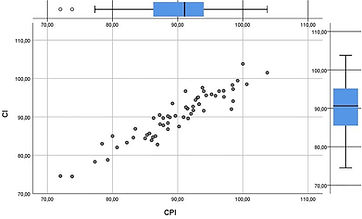
Skully Care makes accurate brachycephaly measurement accessible to both healthcare professionals and parents. For parents measuring at home, the only preparation needed is to dampen the baby's hair slightly with water to make the hairline clearly visible. For professionals using the Skully Care Toolkit in a clinical setting, the measuring cap achieves the same result with even greater precision. Once the baby is positioned correctly, a single photo taken with the Skully Care app is all it takes. The app processes the image immediately and calculates the Cephalic Index and CVAI , with a measurement deviation of just 2%.
For professionals: the Skully Care Toolkit in clinical practice
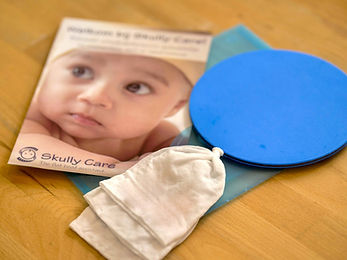
For pediatric physiotherapists and other healthcare professionals, Skully Care offers a toolkit specifically designed for clinical use. The Mat ensures the baby lies in a stable, consistent position for every measurement, which is essential for reliable longitudinal tracking across follow-up appointments. The Cap makes the head shape clearly visible for babies with a lot of hair, ensuring the app can accurately map the skull contours. Traditional manual brachycephaly measurements typically take around 45 minutes per session [source to be added]. Skully Care reduces this to just 5 minutes without any loss in clinical accuracy, freeing up time for treatment and parent communication.
For parents: what to do after measuring at home
Once you have your brachycephaly measurement results, Skully Care helps you determine the right next step. If the Cephalic Index suggests a repositioning approach is appropriate, the app provides personalised exercises you can start at home immediately. These are simple, clearly explained, and designed to fit naturally into your daily routine with your baby. If the results indicate that professional support would be beneficial, the app helps you find a qualified therapist near you. You are never left uncertain about what to do next. Whether that means home exercises or booking an appointment with a specialist, Skully Care guides you straight to the right course of action.
Monitoring progress with regular measurements

Regular brachycephaly measurements are key to understanding whether treatment is working. Skully Care stores all measurements over time and displays them as a clear progress graph, making it easy to track changes in the Cephalic Index across weeks and months. For professionals, this data supports clinical decision-making and makes it easy to determine whether to continue, adjust, or escalate treatment. For parents, seeing the CI move from 95 down toward 88 over a few weeks provides concrete, motivating evidence that repositioning and exercises are having a real impact. Objective progress data also improves the quality of conversations between therapists and parents at every follow-up appointment.
Scientifically validated and trusted worldwide

Skully Care has been independently validated for both validity and reliability by external scientific institutions, confirming it meets the standards required for professional clinical use. More than 1,000 therapists worldwide use Skully Care as part of their daily practice, and a baby is measured with the app every 2 minutes. Comparative testing shows that Skully Care's accuracy is nearly identical to traditional measurement methods, which typically take around 45 minutes per session. For professionals, this makes the transition to Skully Care straightforward. For parents, it means the measurements taken at home carry real clinical weight. Full scientific publications are available here.
Get started with brachycephaly measurement today
Skully Care was founded by Elly van der Grift and Freek Noz, a mother-and-son team. Elly is a pediatric physiotherapist and Freek is an engineer who brings innovation to their mission. Together they built Skully Care to bridge the gap between clinic and home, so that no parent has to wait weeks for an appointment to find out whether their baby's head shape needs attention. Sign up today, take your first measurement in 5 minutes, and get the clarity you need to take the right next step for your baby.
Written by Elly van der Grift

Elly van der Grift is the co-founder of Skully Care and a pediatric physiotherapist with over 30 years of experience. Her mission is to provide top care for babies with skull deformities. With her infectious enthusiasm, she shares simple, effective tips that can make a big difference for your baby. Working with Elly, you'll feel confident and supported in your baby’s journey to better health.